
Beyond Admissions and Discharges: How Virtual Nursing Is Evolving at LifeBridge Health
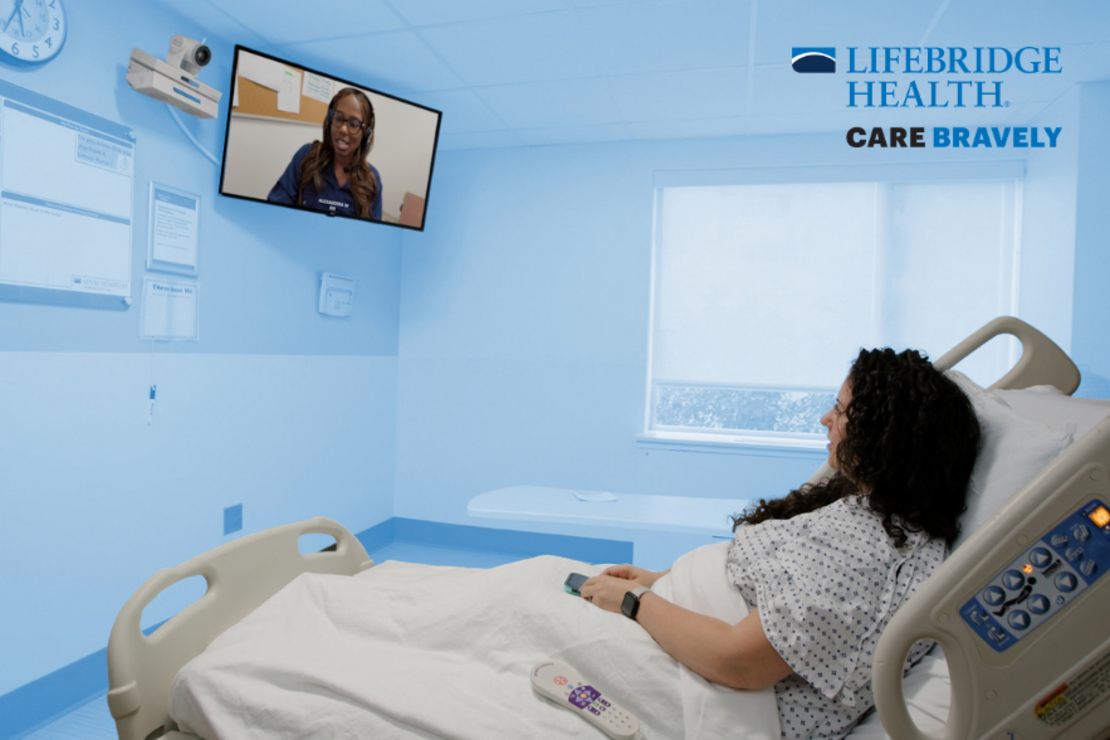
Virtual nursing first gained traction as a way to reduce administrative burden on bedside clinicians and free up their time for hands-on patient care.
For many hospitals, that meant using virtual nurses to support admissions and discharges, two key transitions in a hospital stay that require communication, education and documentation. These responsibilities remain central to virtual nursing today.
But at LifeBridge Health, three years of experience with the model have revealed new opportunities to support patients, families and care teams across the hospital stay.
What Is Virtual Nursing and How Does It Work at LifeBridge Health?
Virtual nursing is a care delivery model that allows registered nurses to support hospitalized patients remotely. It serves as an extension of the care team, providing patients and families with real-time education, coordination and clinical support.
The Technology
At LifeBridge Health, patients in participating units connect with virtual nurses through care.ai cameras, screens and speakers installed directly in their rooms.
To protect patient privacy, these tools never record or store video. Cameras remain directed away from patients when not in use, and virtual nurses must actively connect to a room, alerting everyone present before the interaction begins.
The People
Identifying the right technology and building a scalable program required close collaboration between clinical, operational and technology leaders. But the virtual nurses themselves are central to the program's success.
These are experienced LifeBridge Health nurses who transitioned into virtual roles after years of caring for patients on the very units they now support. Already familiar with the community, care teams and electronic health record (EHR), they remain closely connected to daily operations while working from dedicated on-site virtual care spaces.
Beyond Admissions and Discharges
Today, virtual nurses support patients across 187 beds in Sinai Hospital’s Progressive Care Unit and Northwest Hospital’s Progressive Care, Surgical Orthopedic, Stroke Medical and Observation units.
As teams became comfortable with both the technology and the workflow, they began exploring new ways for virtual nurses to assist patients and clinicians.
"The traditional use case for virtual nursing is admission and discharge support,” says Tamara Sonnenschein, MSN, RN, CNML, nurse manager at Northwest. “But we wanted to go all-in. We knew there was more we could do.”
Depending on the unit and patient needs, virtual nurses now assist with:
- Admissions, including assessments, documentation and medication reconciliation
- Education and orientation, helping patients better understand their treatments, medications and recovery
- Patient experience rounding, answering questions and addressing concerns
- Care coordination, facilitating communication between patients, families and multidisciplinary care teams
- Rapid response support, identifying signs of clinical decline and alerting on-site care teams when urgent intervention is needed
- Pre-discharge planning, including transportation arrangements, caregiver communication and pharmacy coordination
- Discharge education, giving patients and families dedicated time to review instructions, ask questions and prepare for a safe transition home
Rather than engaging only at admission and discharge, virtual nurses can follow a patient’s progress, anticipate needs and provide guidance at multiple points throughout the hospital stay.
To strengthen that continuity, both participating hospitals have a virtual nurse available five days a week.
What the Program Is Teaching Us
When LifeBridge Health’s virtual nursing pilot launched in 2023, it relied on iPads mounted to mobile carts. Since then, the program has been shaped by continuous feedback from patients, nurses and care teams.
The result is not only fixed technology and an expanded task list, but a growing body of lessons that continues to inform virtual nursing across the system.
1. Partnership Drives Success
Technology may enable virtual nursing, but people make it work.
Partnership has been the throughline of this project, whether between:
- Bedside nurses and virtual nurses
- Frontline staff and organizational leaders
- Participating hospitals across the system
Success depends on virtual nurses being integrated into existing care teams and workflows rather than operating as a separate service.
2. Shared Learning Accelerates Growth
“The gift of being in a system is the ability to learn from each other,” says Tamara.
Lessons from Sinai informed Northwest's launch, and insights from both hospitals continue to shape enhancements across the system, shortening implementation timelines and reducing duplicated effort along the way.
As Carroll Hospital prepares to introduce virtual nurses, teams are able to build on tools, processes and best practices shared by their peers.
3. One Size Doesn’t Fit All
Even as they learn from one another, hospital leaders recognize that virtual nursing should not look the same at every site.
Different patient populations, team structures and operational priorities create different use cases for virtual support. The most effective programs reflect those local needs rather than following a single prescribed model.
As Staci Hodge, PA-C, MHA, assistant vice president of the Center for Virtual Care, explains, “The value of thinking about this as a smart-hospital tool is that it allows each site to leverage the technology for the work that they need to do.”
4. Integration Creates New Opportunities
Virtual nursing is one piece of a broader digital transformation taking place across LifeBridge Health, and it becomes even more valuable when connected to the other tools supporting patient care.
At Northwest Hospital, for example, AI-enabled tools through Palantir offer a more complete view of each patient’s progression of care. Virtual nurses can log in each day, identify anticipated discharges and queue those patients up—planning for transportation, prescriptions and caregiver communication.
5. Virtual Nursing is Delivering Value for Both Patients and Clinicians
Frontline staff consistently describe virtual nurses as valuable partners who create more time for direct patient care, while patients benefit from additional opportunities for education, communication and support.
Participating hospitals have seen encouraging trends in patient experience, throughput, readmissions and nurse satisfaction.
One Model, Many Possibilities
Virtual nursing is not defined by a specific technology or task list. Its value comes from how it is integrated into care delivery and adapted to the needs of patients, clinicians and individual hospital units.
To learn more about virtual care across LifeBridge Health, click here.